A Short History of Pasta – Part 1
Where Pasta Really Begins
If you’ve been following along, you know I’ve been diving into Stanley Tucci: Searching for Italy—episode by episode, bite by bite. The journey so far has taken us through Venice, Umbria, and even the heart of London, each destination rich in flavor and history.
But while taking a short break before the next episode, I found myself thinking about something more fundamental:
Where did pasta actually come from?
It shows up in every region, every home, every trattoria. Yet its origin story is tangled in myth, migration, and even politics.
So today, we’re taking a detour from Stanley’s footsteps and heading way back—before the sauces, before the forks, before the stars. This is the history of pasta, Part 1.
Was It Really Brought Back from China?
Let’s start with the most popular myth: Marco Polo introduced pasta to Italy after his travels to China in the 13th century.
It’s a great story—but it’s not true.
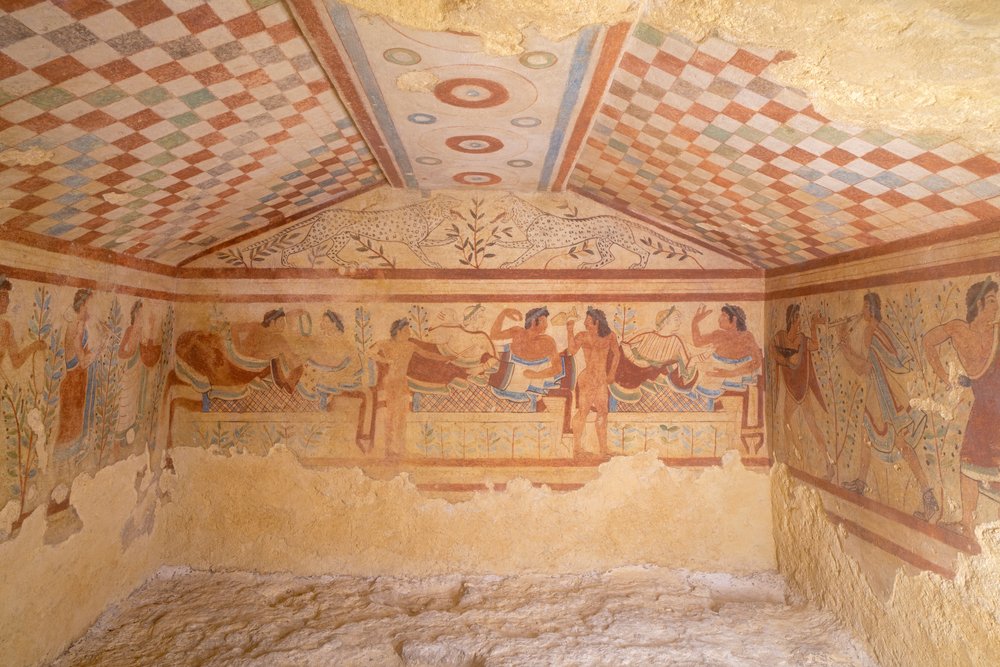
Historical records suggest that Italians were already enjoying pasta long before Marco Polo’s adventures. In fact, references to something resembling pasta appear as early as the 4th century BCE in Etruscan tombs, where carvings show people making a pasta-like dough (National Geographic, 2020). More compellingly, an Arab geographer named Al-Idrisi documented dried noodle production in Sicily in the 12th century—decades before Polo’s journey (Oxford Companion to Food).
The Chinese did have noodles, of course. But so did many other ancient cultures. Pasta, as we know it, likely evolved independently in the Mediterranean (Encyclopedia Britannica).
When the Arabs Brought the Technique

Pasta’s real turning point came during the Arab conquest of Sicily in the 9th century. Alongside new spices and irrigation systems, the Arabs introduced durum wheat and methods for drying dough—transforming soft, handmade noodles into a product that could be stored and transported (Oxford Companion to Italian Food).
This wasn’t just culinary innovation; it was a practical revolution. Dried pasta became a shelf-stable, portable food, perfect for trade and long-distance travel. From Sicily, the technique spread north, reaching the Italian mainland where it would take on regional forms—and a deep cultural identity.
Medieval Italy: The Rise of Regional Pasta

By the Middle Ages, pasta had firmly rooted itself in Italian society. And it wasn’t just food—it was survival.
With the Catholic Church enforcing meatless fasting days, pasta became an essential alternative: filling, versatile, and meat-free (Delizia! by John Dickie). It was also inexpensive and adaptable, made from just flour and water.
Different regions began developing their own versions:
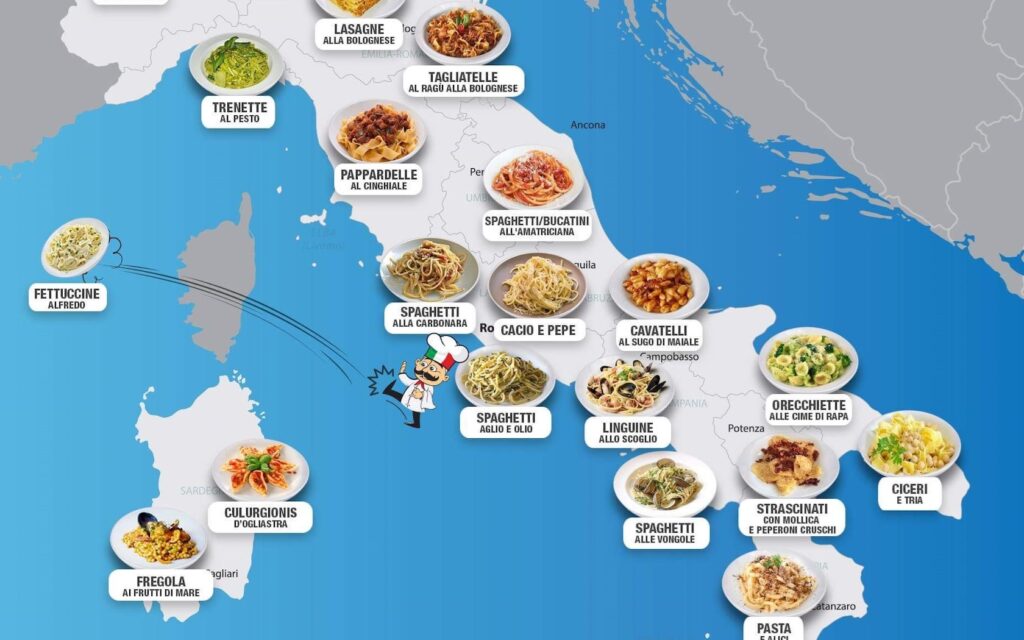
- Naples: long strands like spaghetti
- Emilia-Romagna: hand-rolled sheets for lasagna and tagliatelle
- Liguria: flat ribbons served with basil pesto
(La Cucina Italiana, The Silver Spoon)
The idea of pasta as a unified “Italian” dish didn’t exist yet—but the seeds were planted.
Summary: Key Moments in Pasta History
- Long before Marco Polo, Etruscans were already shaping dough—carving their techniques into stone (~4th c. BCE).
- In the 9th century, Arab innovations brought drying methods and durum wheat to Sicily, transforming pasta into a portable staple.
- From Sicily, pasta moved north, adapting to Italy’s diverse regional cultures and shapes.
- Under Catholic fasting rules, it became the perfect everyday meal—meatless, simple, and deeply satisfying.
- And that was only the beginning. (Part 2 picks up where this story leaves off.)
What’s Next?
👉 Read Part 2: From Italy to the World
Pasta’s journey continues—through machines, migration, and global fame.
References:
- Encyclopedia Britannica – Pasta: Origins and History
- National Geographic (2020) – The History of Pasta
- Oxford Companion to Food, Alan Davidson (not available online)
- Oxford Companion to Italian Food, Gillian Riley (not available online)
- Delizia! The Epic History of the Italians and Their Food, John Dickie (book)
- La Cucina Italiana – Pasta History Articles
- The Silver Spoon (Il Cucchiaio d’Argento) (print edition)